
Best Cordless Drill for Typical Homeowners
Cut through the noise. We compare the power, weight, and battery platforms of top cordless drills to find the best fit for everyday household DIY projects.
Editorial Research Standard
Our conclusions are based on relevant manufacturer specifications, product documentation, warranties, and professional guidance. The evidence used varies by guide and is disclosed below.
Learn more in our Editorial Policy.
For the vast majority of homeowners, the best cordless drill is a 12-volt brushless compact drill/driver, rather than a heavy, expensive 18-volt professional model. It offers the ideal balance of power for driving screws, drilling wall anchors, and light assembly work, without causing hand fatigue or taking up excessive storage space.
Our top recommendation is the Bosch 12V Max Kit (Model PS31-2A) for its light weight and compact size, while those seeking modern brushless performance should choose the Milwaukee M12 Fuel Kit (Model 3403-22).
Cordless Drill Comparison Matrix
| Drill Model | Voltage | Motor Type | Max Torque | Weight (w/ Battery) | Best For |
|---|---|---|---|---|---|
| Bosch PS31-2A | 12V Max | Brushed | 265 in-lbs | 2.1 lbs | Budget-conscious homeowners |
| Milwaukee M12 Fuel 3403-20 | 12V Max | Brushless | 400 in-lbs | 2.5 lbs | Advanced DIYers |
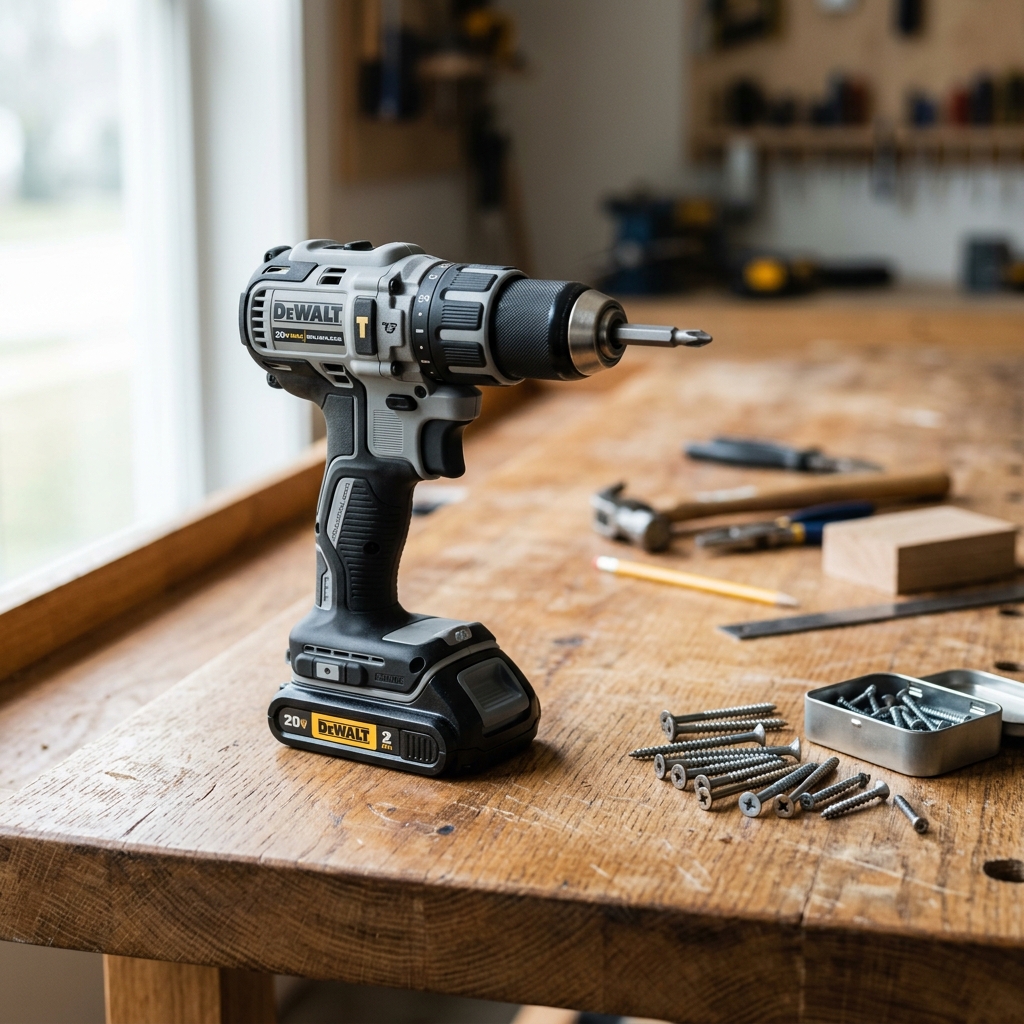
| DeWalt DCD701F2 | 12V Max | Brushless | 250 in-lbs | 2.4 lbs | Ergonomics & comfort |
| Ryobi ONE+ HP PSBDD01K | 18V | Brushless | 400 in-lbs | 2.7 lbs | Multi-tool ecosystem seekers |
1. Top Pick: Bosch PS31-2A 12V Max
The Bosch PS31-2A is a well-regarded, lightweight compact drill suited to everyday household tasks.
- Who it is for: Homeowners who need a drill for assembling flat-pack furniture, hanging curtain rods, installing drywall anchors, or drilling small pilot holes.
- Who it is NOT for: Users looking to drill large holes in masonry, mix joint compound, or drive hundreds of long lag screws into structural lumber.
- Key Specifications: 265 in-lbs torque, 2 speeds (0-350 / 0-1,300 RPM), 3/8-inch chuck.
- Pros: Extremely compact head length (7.0 inches); weighs only 2.1 lbs; includes two batteries.
- Cons: Brushed motor; chuck size is limited to 3/8-inch (cannot accept large 1/2-inch shank bits).
2. Upgrade Pick: Milwaukee M12 Fuel (3403-20)
For homeowners who plan to handle more advanced DIY projects like building decks, repairing fencing, or drilling into metal.
- Who it is for: Dedicated DIYers wanting high torque output in a subcompact frame.
- Who it is NOT for: Homeowners on a strict budget who only use a drill twice a year.
- Key Specifications: Brushless motor, 400 in-lbs torque, 1/2-inch all-metal chuck, 0-1,550 RPM.
- Pros: Heavy-duty all-metal chuck; brushless motor provides more runtime per charge than equivalent brushed models; competitive power-to-weight ratio.
- Cons: Higher initial cost; heavier than the Bosch PS31.
3. Alternative 18V Pick: Ryobi ONE+ HP PSBDD01K
If you intend to expand into outdoor yard tools (lawnmowers, string trimmers) on the same battery platform, an 18V subcompact drill is a smart choice.
- Who it is for: Homeowners looking for a broad, budget-friendly 18V tool ecosystem.
- Who it is NOT for: Those who prioritize the absolute lightest weight and smallest tool footprint.
- Key Specifications: 18V, Brushless motor, 400 in-lbs torque, 1/2-inch chuck.
- Pros: Shares batteries with over 280 Ryobi tools; subcompact HP motor fits into tight spaces.
- Cons: Bulky battery foot limits access to tight angles compared to 12V models.
Decision Guide: Brushless vs. Brushed Motors
When shopping for a drill, you will see options labeled “brushless.”
- Brushed Motors: Use carbon brushes to transfer electrical current. They are cheaper to manufacture but generate friction and heat, slightly reducing battery efficiency. They are perfectly fine for occasional household repairs.
- Brushless Motors: Use a digital controller instead of physical brushes. They run cooler, adjust power delivery based on resistance, and offer increased battery runtime per charge under heavy loads compared to brushed counterparts, according to manufacturer testing. Choose brushless if you plan to use your drill frequently.
Authoritative Sources & Citations
- Robert Bosch Tool Corporation: Bosch PS31-2A Product Specifications and User Manual (Accessed July 2026) - Official documentation detailing the 265 in-lbs torque limit, speed settings, and weight details.
- Milwaukee Electric Tool Corporation: Milwaukee M12 Fuel 3403-22 Product Page and Technical Specs (Accessed July 2026) - Specifications for the 1/2-inch metal chuck, brushless motor, and battery options.
- American Society of Mechanical Engineers (ASME): ASME B107.4-2005 (Driving and Spindle Ends for Portable Powered Tools) (Accessed July 2026) - Standard safety guidelines regulating portable electric drill construction.
Related DwellNinja Guides
- Read our guide on 12V vs. 18V Cordless Drills to determine the voltage path right for your workshop.
- Check our Essential Tools Every Homeowner Should Own list to build out your baseline tool chest.
DwellNinja Editorial Team
Objective Homeowner Advice
The DwellNinja Editorial Team researches manufacturer documentation, product specifications, warranties, and professional guidance to produce practical homeowner guides.
Become a smarter homeowner
Get our twice-monthly homeowner guides and product insights sent directly to you.
Related Guides You Might Like
Best Basic Tool Kits for New Homeowners
Avoid junk plastic kits. We review and compare pre-assembled hand tool kits to help new homeowners buy a durable, high-utility starter set.
12V vs. 18V Cordless Drills
Understand the core trade-offs. We break down the differences in weight, power, battery life, and cost to help you choose between 12V and 18V cordless drills.